


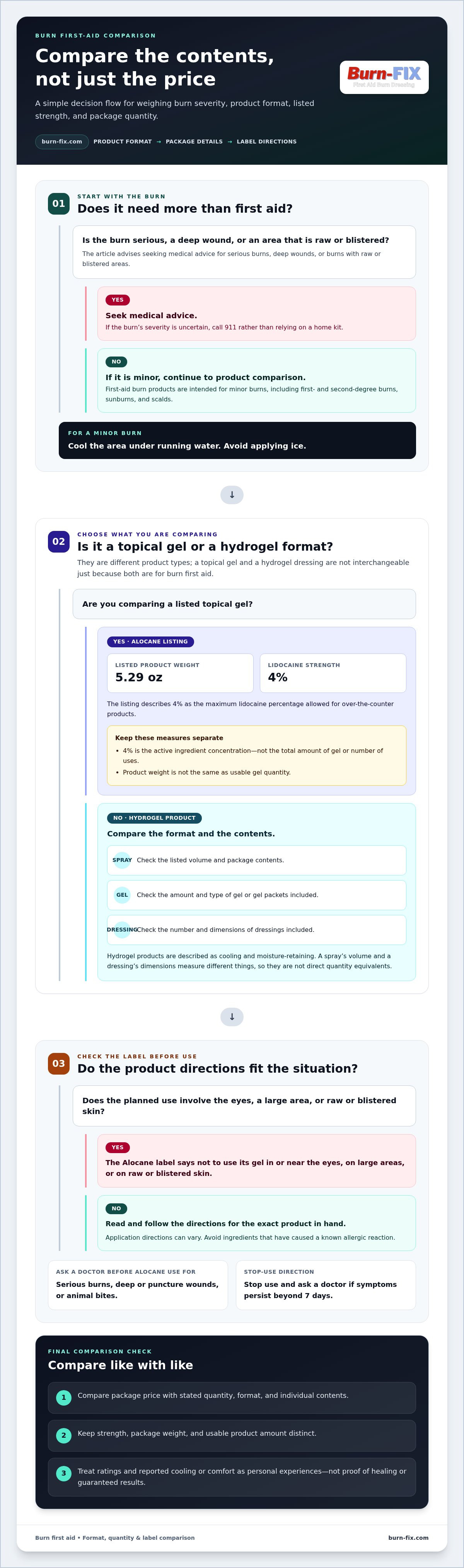
The higher lidocaine percentage isn’t the whole comparison. In an Alocane emergency burn kit versus hydrogel burn kits comparison, the listed Alocane product is 5.29 ounces and contains 4% lidocaine, the maximum percentage allowed for over-the-counter products. Hydrogel kits are compared by the amount and type of gel or dressings included, as well as their cooling, moisture-retaining format.
It makes sense to weigh price against quantity, but contents and intended use matter too. A topical gel and a hydrogel dressing aren’t interchangeable just because both are designed for burn first aid.
This comparison looks at listed prices and quantities alongside product strengths, user ratings, and reported effects, so you can see what each option offers without relying on one number alone. It also explains what label directions say about use and when a burn needs more than a first-aid product. The result is a clearer way to judge which type belongs in your home or emergency kit.
Key Takeaways
- Compare the kit’s individual contents and usable quantity, not just the package price, to judge what you’re getting.
- Read user ratings as personal experiences; they can offer context but don’t establish how a product will work for everyone.
- Check the product label before using a topical gel, especially for warnings about where and when it should be applied.
- For a minor burn, cool the area under running water and avoid applying ice.
- Learn how hydrogel sprays, gel packets, and dressings differ so you can choose a format that fits your first-aid needs.
Prices, quantity, and strength
Price alone can hide important differences between a topical gel and a hydrogel kit. Compare packages with similar contents, then consider the amount and type of supplies included. A kit with dressings and other first-aid items serves a different purpose from a topical gel, so a lower package price doesn’t automatically mean better value.
The Alocane product listing gives a weight of 5.29 ounces and identifies 4% lidocaine as its strength. The listing describes 4% as the maximum percentage of lidocaine allowed for over-the-counter products. That percentage describes the active ingredient’s concentration, not the total amount of gel or the number of uses in the package. Product weight also isn’t the same as usable gel quantity.
Compare hydrogel products by format and package contents. A spray, gel packet, and dressing each deliver the product differently, so check the listed quantity and form. A spray’s volume and a dressing’s dimensions measure different things; neither tells you how many applications someone may need. Match the format to the intended first-aid use, then compare packages on equal terms.
What burn types and sizes can be treated with a first-aid burn kit? First-aid burn products are intended for minor burns, including first- and second-degree burns, sunburns, and scalds. A topical gel label warns against use over large body areas or on raw or blistered surfaces.
What are the risks, contraindications, and allergy warnings for Alocane or hydrogel burn products? The Alocane label says not to use its gel in or near the eyes, on large areas, or on raw or blistered skin. Ask a doctor before use for serious burns, deep or puncture wounds, or animal bites; stop use and ask a doctor if symptoms persist beyond 7 days. Read each product label and avoid ingredients that have caused a known allergic reaction.
When should a burn be treated by a doctor instead of with a home burn kit? Seek medical advice for serious burns, deep wounds, or burns with blistered or raw areas. If the burn’s severity is uncertain, call 911 rather than relying on a home kit.
- Compare the package price with its stated quantity and format.
- Keep strength, package weight, and usable product amount distinct.
- Follow the product label’s warnings and stop-use directions.
User ratings and reported effects
Star ratings can offer context, but they can’t show how a burn product performs in every situation. When comparing Alocane with hydrogel kits, read written reviews alongside their scores. Note the product format, the burn described, and whether the reviewer followed the label directions. A comment about a small kitchen splash, for example, may not apply to a dressing used on another area.
For the Alocane emergency burn kit vs hydrogel burn kits comparison, distinguish reported sensations from other outcomes. “Felt cool” describes a sensation, while “pain eased” reports perceived comfort. Neither statement establishes how quickly skin heals. Burn-Fix hydrogel products provide cooling and retain moisture; reviews may describe personal experiences, but they aren’t controlled tests.
Use a simple reading method:
- Identify the product: Separate comments about topical gel from comments about hydrogel dressings.
- Find the context: Note the burn type, location, and whether the reviewer describes a minor injury.
- Separate sensation from outcome: Cooling or less stinging isn’t the same as a healing claim.
- Look for directions: Reviews are more useful when they explain how the product was applied.
Review patterns can add context, but one dramatic account can’t establish a typical result. If several reviewers say a gel feels soothing but dries quickly, that may help you understand their experience with its texture. It doesn’t mean the product will feel the same for you. A comment about a dressing staying in place reflects one user’s experience, not every body area or burn.
Check whether ratings refer to the same product and package. A kit may contain several items, while reviews might discuss only one component. A reviewer praising a spray’s easy application isn’t necessarily describing a gel dressing. Compare product names and formats, and keep differences in packaging and instructions in mind.
Keep the Alocane emergency burn kit vs hydrogel burn kits comparison grounded in what reviews can show: users’ reported experiences, not proof of medical effectiveness. Be cautious with claims promising a specific healing time or describing a serious burn as suitable for home treatment. A testimonial isn’t a diagnosis. Follow the label for the product in hand, since application directions can vary by product.
For a balanced review check, note the score, review count, date, and product format from the same rating platform. Compare comments about cooling, comfort, application, and packaging separately. This makes personal impressions easier to assess without treating them as guaranteed results.
If you experience a suspected side effect from lidocaine, keep the product details available when seeking advice and consider reporting it. In the United States, side effects from lidocaine may be reported to the FDA at 1-800-FDA-1088. A report is separate from a product rating: describe what happened in clear, specific terms, and avoid presenting a personal experience as evidence that others will have the same result. Seek appropriate professional guidance for concerns.
What is included in the Alocane Emergency Burn Kit?
The Alocane Emergency Burn Kit listing identifies a topical gel product weighing 5.29 ounces. Its stated active strength is 4% lidocaine. These details describe the listed product, but they don’t establish how many separate items or dressings come in every kit. Check the kit’s own package panel to distinguish its contents from the description of one gel container.
A gel packet, dressing, and kit are different units. A packet’s weight doesn’t tell you how many dressings a package includes, and a dressing is a separate physical item. Read the contents list and identify each product form, package quantity, and supporting supply. Don’t mistake the gel’s package weight for the number of dressings included.
The gel’s 4% lidocaine strength tells you its concentration, not how much surface area to treat. Follow the package directions for application, and don’t infer a dose from the total weight. The label warns against using the gel in or near the eyes, over large body areas, or on raw or blistered surfaces. It also advises asking a doctor before use for serious burns, deep or puncture wounds, or animal bites.
For a practical inventory, inspect the sealed kit before placing it in a first-aid area. Record the gel container, any dressings or bandages, and the package directions as separate entries. Then confirm the label remains readable and the container is intact. This simple check helps you spot what is actually on hand instead of assuming that “emergency kit” means a particular set of supplies.
Follow the directions for the specific product you use. Burn-Fix hydrogel dressings retain gel against the affected area; the kit also includes bandages and other supplies. Read the label for instructions on applying and covering the area, and use the included supplies as directed.
Use a clear comparison when evaluating the kit against another burn-care package:
- Product: Identify whether the listed item is gel, spray, or dressing.
- Quantity: Record the container’s stated amount separately from kit contents.
- Strength: Note the active ingredient percentage shown on the label.
- Directions: Review application limits and warnings before an emergency.
Taking inventory gives a more accurate picture than relying on a kit name alone. It also helps you distinguish package weight, product format, and included supplies.
What ingredients and burn-care products are in hydrogel burn kits?
Hydrogel burn care uses a cooling, moisture-retaining gel. Burn-Fix offers it as a spray, gel packets, and dressings. The format affects how you apply it and which supplies you may need. The spray is dispensed from its nozzle, while a dressing places gel against the affected area. Check each product’s label for its ingredients and contents.
Don’t assume that every hydrogel product contains the same active ingredients. A hydrogel describes the product’s gel format, not a guaranteed formula. Check the ingredient panel for active and inactive ingredients, then read the warnings and directions. This matters when comparing a hydrogel product with a lidocaine gel: the ingredient list, rather than the word “burn,” tells you whether lidocaine is present.
For a useful comparison, separate the package into three parts:
- Gel formulation: Read the active ingredient and full ingredient panel.
- Delivery format: Identify spray, individual gel packets, or gel dressing.
- Supporting supplies: Check whether the kit includes coverings or other first-aid items.
A hydrogel dressing combines a gel product with a dressing format. That can make it easier to keep the gel against a particular area, while a spray offers a different application method. Neither format tells you the ingredients by itself. For example, a box containing several dressings may not include a spray or separate gel packets. Count each item separately and follow its own label.
Packaging also affects how you prepare to use the product. A single-use packet is opened for an application; a spray container is dispensed from its nozzle. A dressing is positioned over the area according to its directions. These formats aren’t interchangeable, so match the instructions to the item in hand. Keep the label available, especially if the outer kit contains several product types.
Hydrogel products are designed to provide cooling and retain moisture, which can help soothe minor burns. Their intended role doesn’t replace the first step of cooling the burn under running water for 10 to 15 minutes. Don’t apply ice. After cooling, use the specific hydrogel product according to its label, and protect the area as directed.
When comparing kit contents, make a short inventory before storing the package. Note each gel product, dressing, and other included supply, then read its ingredient panel and directions. That makes differences clear without treating “hydrogel” as a complete ingredient list. It also helps you choose a spray or dressing based on the format you can use correctly.
Are burn gels and hydrogel dressings recommended for minor burns?
Burn gels and hydrogel dressings can be part of first aid for minor burns, including first-degree burns, sunburns, and scalds. They don’t replace the first step: cool the burn under running water for 10 to 15 minutes. Don’t apply ice, which can further injure burned skin.
After cooling the area, follow the product label for the injury and application area. Burn-Fix hydrogel products provide cooling and retain moisture; a gel dressing also places product against the affected area. Topical gels have their own directions and warnings. Don’t assume any first-aid format is suitable for every burn.
Use the label as a practical decision guide. For example, the Alocane gel label warns against use in or near the eyes, over large body areas, or on raw or blistered surfaces. It advises asking a doctor before use for serious burns, deep or puncture wounds, or animal bites. Stop use and ask a doctor if symptoms persist for more than 7 days.
A minor burn should still be watched as it heals. First-degree burns typically heal within 5 to 10 days, while second-degree burns can take up to two to three weeks to fully heal. Those timeframes don’t make a gel or dressing a substitute for medical care when a burn is severe or getting worse.
Once the area is cool, protect it with a loose, sterile bandage and change the covering as needed. Don’t pop blisters, because breaking them increases infection risk. Avoid applying honey, butter, mayonnaise, or oil; these remedies may not be sterile and may cause infection. If gel directions allow covering the treated area, wait until the gel dries before applying a sterile bandage.
Get medical advice rather than relying on a home kit for serious burns, deep wounds, or animal bites. Call 911 if you’re uncertain about a burn’s severity. Seek help promptly if the injury involves a large area or raw, blistered skin, since topical gel labels warn against use in those situations.
- Cool first: Use running water for 10 to 15 minutes, not ice.
- Read directions: Match the product’s warnings to the burn and application area.
- Protect the skin: Use a loose, sterile bandage and leave blisters intact.
Burn-Fix: BurnFix Hydrogel Burn Spray - 120ml
BurnFix Hydrogel Burn Spray - 120ml offers a hydrogel spray option for minor first- and second-degree burns, sunburns, and scalds. Its moisture-retaining formula provides a cooling feel, making it a different format from a lidocaine gel or a gel dressing. After cooling a minor burn under running water, use the spray according to its label directions.
Choose a spray when you want a hydrogel product in an application format rather than a dressing or individual gel packet. Burn-Fix also offers the Burn-FIX 4x4 First Aid Burn Gel Dressing, BurnFix Burn Kit, and BurnFix Burn Gel - 3.5g Per Packet for different first-aid formats. A burn-care product isn’t a substitute for medical attention when a burn is serious or its severity is uncertain.
For details about BurnFix Hydrogel Burn Spray - 120ml, visit Burn-Fix online.
Make your first-aid choice with confidence
Comparing an Alocane emergency burn kit with hydrogel burn kits can help you build a practical first-aid plan. Consider who may use the kit, where it will be stored, and which format is easiest to apply calmly. Read the directions ahead of time and keep the kit somewhere household members can find it. Burn-Fix offers a Burn Kit, spray, gel packets, and dressings for home and travel first-aid supplies. Review the product details and choose the format that fits your kit.
For minor burns, preparation also means knowing when a home product isn’t enough. Keep emergency supplies separate from medical care decisions, and seek urgent help when a burn’s severity is uncertain. If you’re weighing hydrogel formats for your first-aid supplies, Burn-Fix can help you explore its burn-care products. Contact Burn-Fix with your questions and take a calm, informed next step toward being prepared.


