


What if the first step after a minor burn isn’t burn gel? When skin is stinging, it’s natural to reach for something soothing, but burn gel for minor burns comes after cooling, not instead of it. Hold the affected area under cool running water for at least 20 minutes first. This sequence helps you respond calmly without applying ice or household remedies that could make things worse.
It can be hard to tell whether a burn is minor enough for home care or whether gel is appropriate. The burn’s size, depth, and location matter, and a product should be used only as directed.
This guide explains where burn gel fits into first aid after cooling, how to apply it according to the label, and how a clean, loose covering can help protect the area. You’ll also learn which warning signs call for medical attention, so you can seek care promptly rather than risk delaying it.
Key Takeaways
- Understand what burn gel for minor burns can do as a topical first-aid product, and why it doesn’t replace assessment when a burn may be serious.
- Follow a clear first-aid sequence, then use gel only as directed on its product label.
- Compare gel packets, sprays, and dressings to choose a format that suits your first-aid kit and how you prefer to apply it.
- Reassess the burn and watch for worsening symptoms. Knowing when to seek medical attention is part of safe aftercare.
- Keep burn-care supplies accessible and read the packaging instructions before an emergency, so you’re ready to act calmly.
Burn Gel for Minor Burns: What It Does, and What It Does Not Do
A burn can sting and redden the skin in seconds. Burn gel for minor burns is a topical first-aid product applied according to its label. It may provide a soothing layer, but it doesn’t replace cooling the burn, assessing its severity, or seeking medical care when needed. Packets, sprays, and gel dressings are different ways to apply burn-care products, not ways to determine how serious an injury is.
Minor burns are generally small and superficial. Redness and tenderness may be present, but appearance alone can’t confirm burn depth. Skin can change after an injury, and depth may be difficult to judge early on. For background on burn types and the principles of care, see this overview of management of burns.
Which burns may be suitable for home first aid?
A small area of red, tender skin may be suitable for home first aid, but that isn’t a diagnosis. Consider the burn’s size and location, the person’s age and health, and symptoms such as pain or swelling. If you’re unsure about the burn’s depth or whether home care is appropriate, seek professional assessment rather than relying on gel to resolve the uncertainty.
When should you seek medical care instead?
Get medical advice promptly for a burn that looks large or deep, is worsening, or causes unusually severe pain. Burns involving the face, hands, feet, genitals, or a major joint also warrant extra caution. Seek urgent help if there’s trouble breathing, signs of smoke inhalation, or another serious symptom. Chemical and electrical burns need medical assessment, even if the skin injury looks limited.
Use extra caution for children and people who are medically vulnerable, including those with conditions that can affect healing or sensation. If a burn raises concern, don’t delay care while trying different products. Follow the burn gel’s directions, and don’t use it in place of assessment for a serious or uncertain injury.
How to Use Burn Gel After the Initial Cooling Step
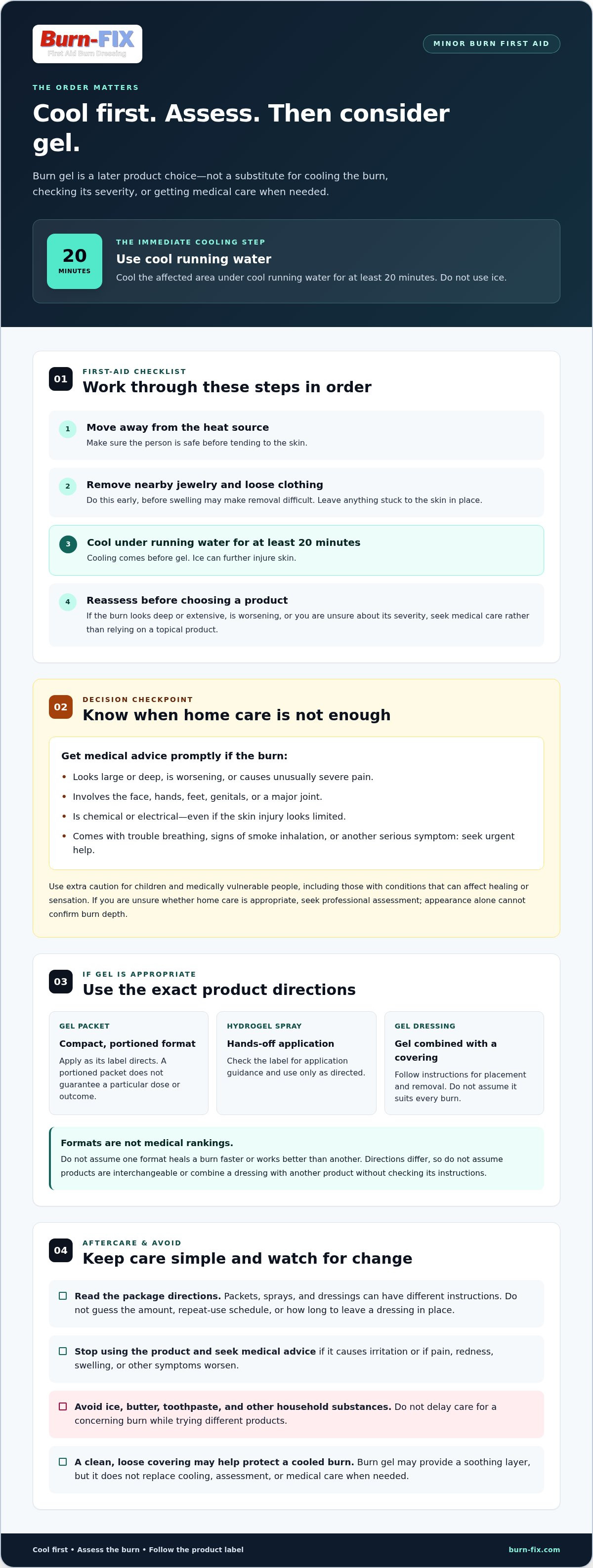
Act in order: move away from the heat, remove nearby jewelry or loose clothing, cool the burn, assess the injury, then follow the gel’s package directions if it’s appropriate. Don’t pull away anything stuck to the skin. Cooling is the immediate first-aid step. Topical gel is a later product choice, not a substitute for cooling or medical assessment.
A simple first-aid sequence for a small burn
- Get away from the heat source. Make sure the person is safe before tending to the skin.
- Remove nearby jewelry and loose clothing. Do this early, before swelling may make removal difficult. Leave stuck material in place.
- Cool the area under cool running water for at least 20 minutes. Don’t use ice, which can further injure skin.
- Reassess the burn. If it looks deep or extensive, is worsening, or you’re unsure about its severity, seek medical care rather than relying on a topical product.
Avoid butter, toothpaste, and other household substances. For more detail on product types and how they differ, see this hydrocolloid and hydrogel burn guide. If the injury may be more than superficial, the guide to treating second-degree burns at home offers a broader care discussion. Burns that raise concern still need professional assessment.
Applying gel carefully
After cooling the burn, read the label for the exact product you have and decide whether home first aid is appropriate. Gel packets, sprays, and dressings can have different directions, so don’t assume they’re applied in the same way. Use the product only as directed. Don’t guess at an amount, repeat-use schedule, or how long to leave a dressing in place.
Stop using the product and seek medical advice if it causes irritation or if pain, redness, swelling, or other symptoms worsen. The American Academy of Dermatology’s guidance on how to treat a first-degree burn provides another reference for minor-burn care. For first-aid preparedness, keep burn-care supplies accessible and review their instructions before you need them. Burn gel packets and other burn-care formats are among the options available in the Burn-Fix first-aid range.
Burn Gel vs. Other First-Aid Options: Choosing a Suitable Format
Once a burn has been cooled and assessed, the format you choose can affect how easy the product is to apply and store. Packets, sprays, and gel dressings are options for first-aid use, but they aren’t medical rankings: don’t assume one format heals a burn faster or works better than another. For burn gel for minor burns, follow the product label and choose a format you can use calmly and correctly.
Gel packets, sprays, and dressings: what differs?
A packet contains gel in a compact, portioned format. A spray offers hands-off application, while a gel dressing combines gel with a covering. Burn-Fix offers gel packets, hydrogel burn spray, and burn gel dressings. Check each package for its directions and cautions. Don’t assume formats are interchangeable or that a dressing can be used with another product.
| Format | Use context and handling | Key caution |
|---|---|---|
| Gel packet | A compact option for a first-aid kit; apply as the label directs. | A portioned packet doesn’t guarantee a particular dose or outcome. Follow its instructions. |
| Hydrogel spray | A spray format for applying product without spreading it directly by hand. | Use only as directed, and check the label for application guidance. |
| Gel dressing | Combines gel with a dressing format to cover the affected area. | Follow instructions for placement and removal. Don’t assume it suits every burn. |
| Ordinary dressing | A clean, loose covering may protect a cooled burn. | It isn’t automatically a burn gel product. Avoid anything that sticks to the injury. |
Burn gel is different from an ointment, and both differ from household remedies. Some authoritative guidance describes using a thin layer of certain ointments after cooling; see MedlinePlus’ advice on Caring for a minor burn. That doesn’t mean every gel or ointment is suitable for every injury. Check the product directions rather than substituting one topical product for another.
What should you avoid putting on a fresh burn?
Don’t apply ice, butter, toothpaste, or other unverified household remedies. Ice can injure the skin, while creams or substances not intended for burns may irritate the area or make it harder to assess. Cool running water is the first-aid step; a topical product comes later, if appropriate. Choose a format you can handle and store, not one based on an unsupported promise of superior results.
For a practical kit option, keep burn-care supplies with your other first-aid essentials, such as the Burn-Fix burn-care formats, and read their packaging before an emergency.
Safe Burn Gel Use: Aftercare, Red Flags, and Common Mistakes
Keep checking the burn after initial first aid. Its appearance and symptoms can change, so don’t assume it’s minor simply because it first looked small. Use burn gel for minor burns only as directed on the product label, and seek clinical advice if you’re worried or the injury is getting worse. Gel can’t treat a deep burn, an infection, or an injury that needs professional care.
Worsening pain, spreading redness, increasing swelling, pus, fever, or a burn that appears deep or extensive calls for prompt medical assessment. Trouble breathing, faintness, or signs of shock after a burn require emergency help.
Signs that a burn needs professional assessment
Consider the whole picture: the burn’s size, how deep it appears, where it is, and who is injured. Burns on the face, hands, feet, genitals, or over a major joint deserve particular caution. Children and people with health conditions that may affect healing or sensation may also need a lower threshold for seeking advice.
Arrange prompt assessment if pain or redness worsens, the area becomes increasingly swollen or warm, or you notice discharge or fever. Use emergency services for severe symptoms such as breathing difficulty or collapse. For a smaller burn that isn’t improving or raises concern, contact a healthcare professional for guidance. Don’t wait for gel to work if the injury may be serious.
Common mistakes when treating a minor burn
Small choices matter. Don’t apply ice, peel away loose skin, or break blisters. Avoid butter, toothpaste, and other unapproved substances; they can irritate injured skin or make it harder to assess. If you cover the burn, use a clean, loose covering that won’t stick to the affected area, and follow the product label for any gel dressing.
Keep aftercare simple: keep the area clean, follow the instructions for the product you used, and watch for changes. Don’t apply it more often or for longer than the label directs. Stop using a product if it causes irritation, and seek advice if symptoms worsen or you’re unsure about the wound. Delaying assessment of a deep, large, or infected burn can allow a problem to progress when timely care is needed.
For practical preparation, use this essential home emergency burn kit checklist to plan what to keep accessible. Explore the Burn-Fix burn kit and burn-care supplies as you organize your first-aid essentials.
Choosing Burn Gel for Your First-Aid Kit: A Calm Next Step
A useful burn-care item is one people can find quickly and use according to its instructions. Choose a format that suits where the kit will be kept, who may need to use it, and what feels manageable in a stressful moment. Burn gel for minor burns is a first-aid supply, not a substitute for cooling the injury or seeking care when its size, depth, or symptoms raise concern.
What to consider when adding burn gel to a kit
Think about the setting first. A home kit may be shared by several people, while a personal or travel kit may need supplies that are easy to store and identify. Check that the packaging directions are readable and that someone likely to use the kit can understand them. Keep burn-care items with other first-aid essentials, somewhere accessible rather than tucked away where they’re hard to find.
- Review the packaging. Check that it’s intact, read the directions, and note expiration information where provided.
- Follow storage instructions. Keep the product in the conditions stated on its label so you can refer to its guidance when needed.
- Plan beyond the product. Keep basic burn first-aid guidance with the kit and know how to reach local emergency help if an injury is serious.
A little preparation helps reduce guesswork. Before an emergency, make sure household members know where supplies are and understand that a burn should be cooled and assessed before deciding whether a topical product is appropriate. Labels can differ, so review the instructions for each format rather than assuming they’re interchangeable.
Explore Burn-Fix burn-care options
Burn-Fix offers Burn-Fix Burn Gel in a 3.5 g packet, a compact format for first-aid preparedness. Other options include hydrogel burn spray, burn gel dressings, and the Burn-Fix Burn Kit. These are distinct formats; compare their packaging and directions to decide what fits your storage needs and how you prefer to handle first-aid supplies. No format replaces professional assessment when a burn appears deep, extensive, or is getting worse.
Build a kit around clear instructions and accessible supplies, then review the packaging so you’re familiar with it before it’s needed. If you’re ready to add a burn-care option to your first-aid setup, explore Burn-Fix burn-care products.
Be Ready to Respond with Confidence
The safest approach is simple: cool the burn first, then consider a topical product only if the injury appears suitable for home first aid. Burn gel for minor burns may fit into that next step, but it doesn’t replace careful assessment or professional care when a burn is deep, extensive, worsening, or otherwise concerning.
Choose a format that’s easy to store and use, and read its directions before an emergency. Burn-Fix offers BurnFix Burn Gel in 3.5 g packets, as well as hydrogel spray, gel dressings, and a burn kit. Each format serves a different first-aid-kit purpose, so preparation starts with knowing what you have and where to find it.
Organize your supplies and keep burn-care instructions accessible. Explore Burn-Fix burn-care products as you prepare your first-aid kit. With clear steps and supplies close at hand, you can respond calmly and recognize when it’s time to seek medical help.
Frequently Asked Questions
Can you put burn gel on a minor burn?
Yes, burn gel may be used on a minor burn if the product is intended for that use and its label says it’s appropriate for the injury. Cooling the skin is a separate first-aid step, and gel doesn’t replace medical assessment. If the burn is large, deep, worsening, or difficult to judge, seek professional guidance instead of relying on a topical product. Stop use and seek advice if irritation develops.
Should I put burn gel on before or after cooling the burn?
Cool the burn before applying gel. Move away from the heat source, then hold the affected area under cool running water for at least 20 minutes. Don’t use ice. After cooling, assess the injury and follow the gel’s package directions if home care seems appropriate. If the burn looks serious, its depth is uncertain, or the person feels unwell, seek professional advice or emergency care rather than delaying for gel.
Does burn gel prevent blisters?
No burn gel should be relied on to prevent blisters. Blistering can depend on the burn’s depth and may appear after the initial injury, so keep checking the skin and symptoms. Don’t pop blisters or peel skin. Follow the product label for any topical care, and seek clinical advice if the burn is large, worsening, unusually painful, or otherwise concerning. A topical product can’t determine how serious a burn is.
Can you use burn gel on a child?
Whether burn gel is suitable for a child depends on the child’s age, the burn’s size and location, and the product’s label. Don’t assume every gel is appropriate for every child or injury. Seek prompt professional guidance for an infant or young child, a burn in a sensitive area, or any injury whose severity is uncertain. Gel doesn’t replace assessment, particularly if symptoms worsen or the child seems unwell.
What should you not put on a minor burn?
Don’t put ice, butter, toothpaste, or other unverified household remedies on a burn. Ice may further injure skin, and other substances can irritate the area or complicate assessment. Don’t peel skin or break blisters. Cool the burn with running water, assess it, and follow the label for any topical product you use. For a severe, worsening, or uncertain injury, seek medical care rather than relying on home remedies.
When should I seek medical care for a burn instead of using gel?
Seek professional assessment for a burn that’s large, deep, worsening, or unusually painful, or that affects a sensitive area such as the face, hands, feet, genitals, or a major joint. A person’s age and health can also affect the decision. Get urgent help for serious symptoms such as breathing difficulty or collapse. Burn gel can’t treat a serious injury, so don’t let applying it delay needed care.
Can burn gel be used on an open or blistered burn?
It depends on the injury and the specific product directions, so don’t assume every gel is suitable for broken or blistered skin. Read the label carefully and don’t pop blisters or peel skin. Seek medical guidance for an open, large, worsening, or uncertain burn, or if you notice concerning symptoms such as increasing pain or signs of infection. A topical product isn’t a substitute for assessment when care may be needed.


