


A blistering burn can look manageable at first, yet it may need more than a quick covering. If you’re wondering how to treat second degree burns, start by checking where the burn is and how large it is, then cool it with cool running water. Don’t use ice or try to pop blisters.
It’s understandable to feel unsure when skin is red, swollen, painful, or blistered. Burn depth can be difficult to judge at home, and the wrong remedy may irritate the injury or increase infection risk. The safest approach is to give gentle first aid while watching for signs that medical care is needed.
This guide explains how to recognize a second-degree burn, what to do right away, and which home remedies to avoid. You’ll also learn how to cover and protect the area as it heals, when a burn needs urgent or emergency attention, and when to seek follow-up care. Clear steps can help you act calmly and protect the burn without delaying needed medical assessment.
Key Takeaways
- Learn how to treat second degree burns with a calm first-aid sequence that protects the injured skin.
- Use simple triage checks to distinguish burns that need emergency help, prompt clinical advice, or may be suitable for cautious home care.
- Keep blistered skin protected and intact, and know when changes in the burn call for medical advice.
- Understand why burn depth, size, location, and personal health can affect recovery and follow-up needs.
- See how suitable first-aid supplies can help you prepare, while recognizing they don’t replace medical assessment when it’s needed.
How to Recognize a Second-Degree Burn and Act Safely
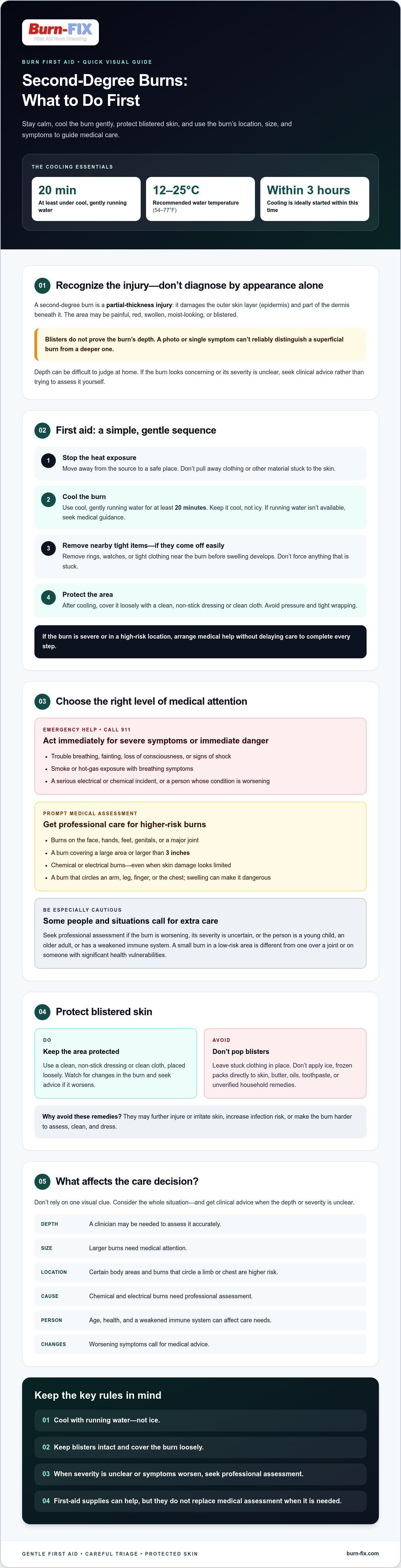
If the person is in immediate danger or has severe symptoms, call 911 first. Trouble breathing, fainting, or a burn caused by a serious electrical or chemical incident needs urgent attention. Once everyone is safe, focus on the burn and get medical advice if its depth or severity is unclear. Knowing how to treat second degree burns begins with careful triage, not a guess based on appearance.
A second-degree burn is a partial-thickness injury that damages the outer skin layer, called the epidermis, and part of the dermis beneath it. This broad classification of burns includes injuries of different depths, and a clinician may be needed to assess them accurately.
What does a second-degree burn look and feel like?
The area may be painful, red, swollen, moist-looking, or blistered. Blisters can occur, but they don’t prove a burn’s depth, and a photo or single symptom can’t reliably distinguish a superficial partial-thickness burn from a deeper one. Pain and appearance vary. If the injury looks concerning or you’re unsure how deep it is, seek clinical advice rather than trying to diagnose it yourself.
Depth is only part of the decision. Size, location, cause, the person’s age and health, and changing symptoms all affect whether home care is appropriate. A small burn in a low-risk area is different from one over a joint or on a person with significant health vulnerabilities.
When should you call 911 or seek urgent care?
Call 911 for an immediately dangerous situation or severe symptoms, such as breathing difficulty, loss of consciousness, or signs of shock. Smoke or hot-gas exposure with breathing symptoms also needs emergency help. Don’t delay to assess the skin if the person’s condition is worsening.
Arrange prompt medical assessment for a burn on the face, hands, feet, genitals, or a major joint, or one that covers a large area. A burn larger than 3 inches also warrants medical attention. Chemical and electrical burns need professional assessment, even if the skin damage looks limited. A burn that circles an arm, leg, finger, or the chest can become dangerous as swelling develops, so seek urgent care.
Be especially cautious with young children, older adults, and people with weakened immune systems. If the burn is worsening or you can’t confidently judge its severity, choose professional assessment over home treatment. When in doubt, getting timely advice is the safer next step.
Immediate First Aid for a Second-Degree Burn: Cool It Gently
Act promptly, but keep the response simple. Stop the burning process, cool the area, remove nearby constricting items if they come off easily, then protect the burn. Current guidance recommends cool running water at 12-25°C (54-77°F) for at least 20 minutes, ideally within three hours of the injury. If you’re learning how to treat second degree burns, begin with these steps rather than reaching for a household remedy.
What should you do in the first few minutes?
- Stop the heat exposure. Move away from the source to a safe place. Don’t pull away clothing or other material stuck to the skin.
- Cool the burn. Hold the area under cool, gently running water for at least 20 minutes. Keep the water cool, not icy; if running water isn’t available, seek medical guidance.
- Remove tight items nearby. Take off rings, watches, or tight clothing near the burn before swelling develops, if they come away easily. Don’t force anything that’s stuck.
- Protect the area. After cooling, cover it loosely with a clean, non-stick dressing or clean cloth. Avoid pressure and don’t wrap tightly.
These steps align with patient-focused first aid for burns. If the burn is severe or in a high-risk location, arrange medical help without delaying care to complete every step.
What should you avoid putting on a fresh burn?
Skip ice, very cold water, and frozen packs placed directly on the skin. Extreme cold can further injure burned tissue, so use cool running water instead. The distinction between cooling with water and applying ice is also discussed in this hydrogel-versus-ice burn guide.
Don’t pop blisters or apply butter, oils, toothpaste, or other unverified household remedies. These can irritate the skin, make the burn harder to assess, or complicate cleaning and dressing it. If clothing is stuck to the burn, leave it in place and get medical advice rather than trying to peel it away.
Hydrogel spray or gel may be an optional first-aid supply, but it doesn’t replace cooling or medical assessment. Follow the product label and clinician advice, including any age-related cautions. A burn-care kit can help keep first-aid supplies together; check the Burn-Fix Burn Kit as one option, not a substitute for care when the injury needs assessment.
Can a Second-Degree Burn Be Treated at Home? Use These Triage Checks
Not every second-degree burn is suitable for home care. A burn’s size, location, likely depth, cause, and how it changes over time all matter. The person’s age and health matter, too. Use the guide below to choose a next step, not to diagnose the injury; if you’re unsure, contact a medical professional for advice.
| Level of care | When it may apply | What to do |
|---|---|---|
| Emergency help | The person has trouble breathing, faints, shows signs of shock, or the burn is extensive, deep-looking, rapidly worsening, or circles a limb or the chest. | Call 911 or your local emergency number. Don’t delay to assess the burn yourself. |
| Prompt clinical advice | The burn is larger than 3 inches; affects the face, hands, feet, genitals, or a major joint; or resulted from a chemical or electrical exposure. Seek advice as well if it limits movement or symptoms are worsening. | Contact a healthcare professional promptly. Children under 5, adults over 70, and people with a compromised immune system should be assessed with extra caution. |
| Possible minor-burn home care | The injury appears small and superficial, the person is otherwise well, and none of the warning signs above are present. | Follow appropriate first-aid steps, protect the area, and watch for changes. Seek medical advice if you’re uncertain or the burn worsens. |
Which burns need emergency or prompt medical assessment?
Get help quickly if a burn looks deep, covers a large area, interferes with movement, or is getting worse. Electrical and chemical burns need professional advice even when the visible mark seems small, because the injury may be more serious than it appears. Burns on sensitive areas or over joints also deserve prompt assessment. For young children, older adults, and anyone with relevant health conditions, use a lower threshold for seeking care.
When might careful home care be reasonable?
Home care may be reasonable for a small, superficial burn when the person feels well and no concerning signs are present. Still, appearance alone can’t confirm burn depth. The question of how to treat second degree burns safely depends on the whole situation, not one symptom or a checklist. If the cause, depth, or right next step is unclear, ask a healthcare professional rather than relying on home care alone.
How to Protect a Blistering Burn and Monitor Healing
Once the burn has been cooled and assessed for urgency, keep it clean and shielded from rubbing. A blister helps cover the injured skin, so don’t deliberately pop, squeeze, or peel it. If it breaks on its own, avoid tearing away attached skin and seek medical advice if you’re unsure how to care for it.
How should you cover a burn without irritating it?
If appropriate for the injury, cover it loosely with a clean, non-adherent dressing that won’t stick to the burn. Avoid tight wrapping, which can put pressure on swollen tissue. The right dressing depends on the burn’s severity and location, so follow a clinician’s instructions if the burn has been assessed. Seek advice if a blister is large, painful, or otherwise concerning.
Hydrogel dressings are one first-aid supply option, but they don’t replace medical assessment or individualized instructions. Burn-Fix offers hydrogel burn dressings; use any product only as directed on its label and in line with clinician advice. For preparedness rather than treatment instructions, see this home burn-kit checklist.
What changes mean the burn needs follow-up?
Check the area for changes instead of assuming that pain or redness is part of normal healing. Contact a healthcare professional if redness or swelling increases, pain worsens or persists, or you notice drainage, pus, an unpleasant odor, or fever. These signs need professional advice; don’t try to manage them by repeatedly applying new products or changing the care plan on your own.
- Follow the care plan. If a clinician has assessed the burn, use their instructions for dressing changes and reassessment.
- Watch for a change in function. Increasing tightness or difficulty moving the affected area deserves medical attention, particularly near a joint.
- Ask if the dressing causes concern. If it sticks, becomes wet or dirty, or you’re unsure how to change it, get guidance rather than pulling it off the injured skin.
Learning how to treat second degree burns includes knowing when home care is no longer enough. If symptoms are worsening or you’re uncertain about the burn’s depth or healing, seek professional advice. To keep optional first-aid supplies on hand, explore BurnFix burn-care supplies, and follow product labeling without delaying needed medical care.
Second-Degree Burn Recovery: Follow-Up, Prevention, and First-Aid Supplies
Recovery doesn’t follow one schedule. It depends on the burn’s depth, size, and location, as well as the person’s overall health. Deeper or more complicated burns may need professional wound care, so don’t assume that home supplies alone are enough. Knowing how to treat second degree burns also means following through after the initial first aid.
What should you know about healing and follow-up?
If a clinician has assessed the burn, follow their directions for care and attend recommended reassessments. Contact them sooner if symptoms worsen or new concerns appear. A burn that hasn’t healed within two weeks should be re-evaluated by a medical professional. That’s a reason to seek follow-up, not a prediction of how long any particular burn will take to heal.
Keep track of changes and ask for guidance if you’re unsure whether the wound is improving. Individualized advice matters because a burn’s depth, location, and the person’s health can affect care needs. Avoid changing a clinician’s instructions or repeatedly trying new products without checking first.
What burn-care supplies can help you stay prepared?
A well-organized first-aid kit can help keep appropriate supplies close at home, including clean dressings and other items intended for burn first aid. Burn-Fix offers hydrogel spray, burn gel, hydrogel dressings, and burn kits. These are optional supplies, not a replacement for professional assessment. Follow each product’s label and any clinician advice, including age-related cautions, and seek medical care if the burn is serious or symptoms change.
Preparation can also mean reducing common risks. Keep hot drinks and cookware away from children’s reach, use care around hot surfaces, and make sure household members know where first-aid supplies are kept. For practical kitchen preparedness, review this kitchen safety first-aid guide.
Choose supplies that suit your household and keep them accessible, while remembering that a kit can’t determine burn depth or provide medical care. For optional burn-care supplies to include in your preparation, explore Burn-Fix burn-care supplies.
Be Ready to Respond With Confidence
Knowing how to treat second degree burns starts with calm triage: appearance alone can’t confirm burn depth, and some injuries need prompt professional assessment. For a burn that may be minor, gentle first aid and clean, non-stick protection can help you care for the area while you monitor for changes.
Keep following a clinician’s instructions if the burn has been assessed, and seek advice if symptoms worsen or you’re unsure about recovery. First-aid supplies can make it easier to respond, but they don’t replace medical care when it’s needed. Burn-Fix offers hydrogel spray, gel, dressings, and burn kits for preparedness; use products only as directed by their current labels and clinician advice.
Explore Burn-Fix burn-care supplies to see optional items for your first-aid kit. With clear steps and the right support, you can respond thoughtfully and help protect yourself or someone you care for.
Frequently Asked Questions
What is the fastest safe way to treat a second-degree burn?
Start by moving away from the heat source, then cool the burn under cool running water for at least 20 minutes. Remove nearby rings or watches if they come off easily, and loosely cover the area with a clean, non-stick dressing. Don’t use ice, butter, or toothpaste. If you’re unsure how to treat second degree burns safely, or the injury is severe, seek medical advice promptly.
Can you treat a second-degree burn at home?
Sometimes, but home care is only a possibility for a small, superficial burn when the person is otherwise well and no warning signs are present. Burns on the face, hands, feet, genitals, or major joints, burns larger than 3 inches, and chemical or electrical burns need medical assessment. Children, older adults, and people with compromised immune systems may need extra caution. If uncertain, contact a healthcare professional.
Should you pop a blister from a second-degree burn?
No. Leave the blister intact because its covering helps protect the injured skin. Don’t puncture, squeeze, or peel it, as this can expose the area and complicate care. If it breaks on its own, gently clean the area with mild soap and water, then cover it with a clean, non-stick dressing. Seek medical advice if the blister is large, very painful, or concerning.
When should you go to the ER for a second-degree burn?
Go to the ER or call 911 for severe symptoms such as trouble breathing, fainting, signs of shock, or a large or deep-looking burn. Seek prompt medical assessment for burns on the face, hands, feet, genitals, or major joints, or burns larger than 3 inches. Chemical and electrical burns also need professional assessment. If the injury is worsening or limits movement, don’t rely on home care alone.
How long should you cool a second-degree burn with running water?
Cool the burn under cool running water for at least 20 minutes, ideally within 3 hours of the injury. Guidance describes water around 12-25°C (54-77°F); it should feel cool, not icy. Don’t apply ice or frozen packs directly to the skin. If the burn is severe or medical help is needed, cooling shouldn’t delay emergency care.
What should you put on a second-degree burn after cooling it?
For a minor burn, a thin layer of petroleum jelly and a loose, clean, non-stick dressing may be appropriate. Avoid butter, oils, toothpaste, and unprescribed antibiotic ointments; follow clinician advice if the burn has been assessed. Hydrogel spray, gel, or dressings are optional first-aid supplies. Use them only according to current product-label directions, and don’t let them delay medical assessment when needed.
What are the signs that a second-degree burn is infected?
Possible warning signs include increasing redness or swelling, worsening pain, pus or other drainage, a foul odor, or fever. A burn that becomes more painful or looks worse rather than improving should be checked by a healthcare professional. Don’t try to manage concerning changes by repeatedly applying products or changing the dressing plan on your own. Seek prompt advice, especially if symptoms are spreading or the person feels unwell.


