


A workplace can have a stocked first-aid kit and still be unprepared for likely burn hazards. The workplace burn kit essentials for a kitchen, workshop, or production floor can differ because heat and chemical risks, site layout, and access to water affect what staff need. A standard kit may not be enough, and supplies are of little use if employees cannot find them quickly.
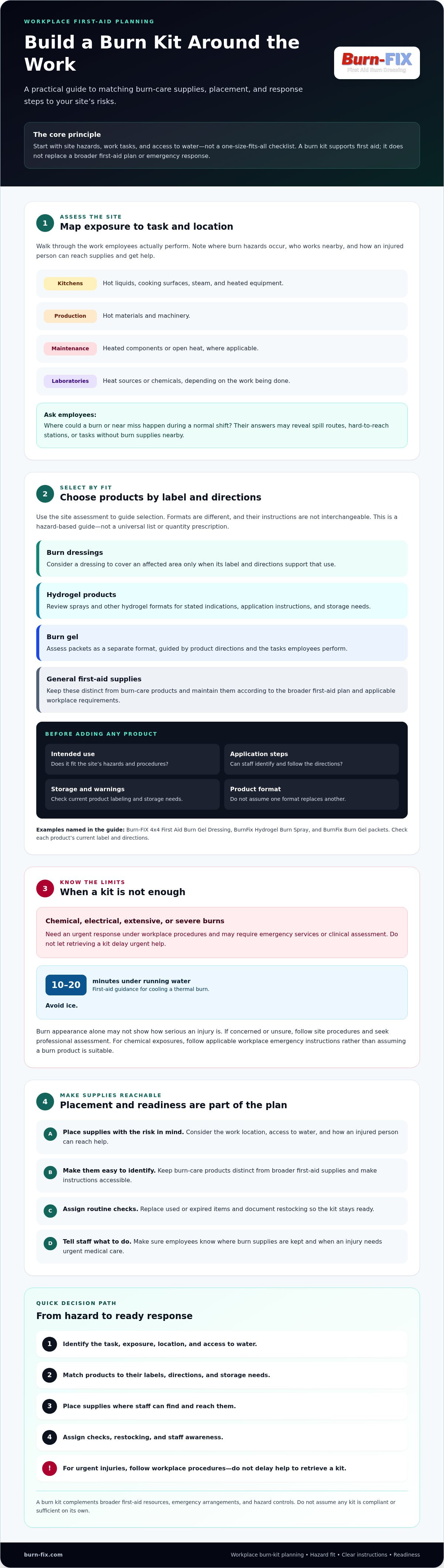
Start with the hazards, not a one-size-fits-all checklist. This guide explains how to assess burn risks, select burn-care supplies based on their labels and directions, and place them where staff can reach them. It also covers assigning routine checks, replacing used or expired items, and making sure employees know when to seek urgent medical care. Clear placement and response steps help burn supplies complement your broader first-aid plan.
Key Takeaways
- Use your site’s burn hazards, work tasks, and access to water to guide supply choices instead of relying on a one-size-fits-all list.
- Match burn dressings, hydrogel products, and burn gel formats to their labels and directions, and keep them distinct from broader first-aid supplies.
- Evaluate workplace burn kit essentials by hazard fit, clear instructions, accessible placement, storage needs, and ease of replenishment.
- Assign someone to check supplies, replace used or expired items, and document restocking so the kit stays ready.
- Tell staff where burn supplies are kept and when an injury requires urgent medical care.
Workplace Burn Kit Essentials Start with Your Site’s Burn Risks
A useful burn kit starts with the work, not a generic shopping list. The workplace burn kit essentials for a café may differ from those for a maintenance area because the likely exposures, work locations, and staff response plans are different. Burn-specific supplies can support first aid for minor burns, but they do not replace a broader first-aid kit, emergency equipment, or procedures for contacting emergency services.
Walk through the tasks employees actually perform. Note where heat or other burn hazards are present, who works nearby, and how an injured person could reach supplies and get help. For background on different types of burns, use an overview as context, not as a substitute for workplace procedures or medical assessment.
Which workplace tasks create the greatest burn risk?
Connect each exposure source to a task and location. In a kitchen, consider hot liquids, cooking surfaces, steam, and heated equipment. In production areas, look for hot materials and machinery. During maintenance, consider heated components or open heat where applicable. Laboratories may involve heat sources or chemicals, depending on the work being done.
Ask employees where a burn or near miss could happen during a normal shift. Their answers may reveal a spill route, a hard-to-reach station, or a task where staff handle hot materials without burn supplies nearby. Use those findings to decide where to place supplies and which labeled burn-care products to consider.
When is a burn kit not enough?
A kit supports first aid, but it is not a treatment plan for every injury. Chemical, electrical, extensive, or severe burns need an urgent response under workplace procedures and may require emergency services or clinical assessment. For thermal burns, first-aid guidance recommends cooling the affected area under running water for 10 to 20 minutes and avoiding ice. Do not let retrieving a kit delay urgent help.
Burn appearance alone may not show how serious an injury is. If the injury is concerning or you are unsure what to do, follow site procedures and seek professional assessment. For chemical exposures, use the workplace’s applicable emergency instructions rather than assuming a burn product is suitable. Check its label and directions before use.
Keep the roles clear: burn-care supplies address a specific first-aid need, while general first-aid resources, emergency response arrangements, and hazard controls serve broader purposes. A Burn-Fix Burn Kit is one option to evaluate for a workplace setup. Check its current labeling and directions against the site’s risks, and do not assume any kit is compliant or sufficient on its own.
What Workplace Burn Kit Supplies Should You Consider?
Choose supplies based on the exposures identified in your site assessment, then check that each item’s intended use fits your workplace procedures. The workplace burn kit essentials for a splash risk may differ from those for a hot surface or equipment task. Keep burn-care products distinct from general first-aid supplies and emergency resources. A burn kit can complement a broader first-aid plan, but it is not a complete workplace response system.
Use this hazard-based checklist to guide selection. It is not a universal list or a quantity prescription:
- Burn dressings: Consider a dressing for covering an affected area only when its label and directions support that use.
- Hydrogel products: Review sprays and other hydrogel formats for their stated indications, application instructions, and storage needs.
- Burn gel: Assess packets as a separate format, using product directions and the tasks employees perform to guide your decision.
- General first-aid supplies: Maintain these separately according to your wider first-aid plan and applicable workplace requirements.
Burn dressings, gels, and sprays: how the formats differ
A dressing is designed to cover an area when its product directions support that use. Gels and sprays are different formats, and their instructions are not interchangeable. Do not assume every product suits every injury or that one format can replace another. For a closer comparison of dressing materials, see this workplace guide to hydrocolloid versus hydrogel dressings.
Burn-Fix offers products in these categories, including the Burn-FIX 4x4 First Aid Burn Gel Dressing, BurnFix Hydrogel Burn Spray, and BurnFix Burn Gel packets. Check each product’s current label and directions before deciding whether it fits your site’s needs.
What to check before adding a product to the kit
Read the label for intended use, application steps, storage conditions, and warnings. Choose packaging staff can identify quickly and use under workplace procedures. Make sure relevant employees know where the instructions are kept. If a product’s use or storage requirements do not suit the work area, choose a better fit rather than relying on guesswork.
Kit contents vary. Do not assume the BurnFix Burn Kit includes specific items, quantities, or features. Review its current product information before evaluating it for your setup. You can review the BurnFix Burn Kit as one option, while keeping in mind that burn-care products support first aid and do not replace professional medical care or a broader workplace first-aid plan.
How to Compare Workplace Burn Kits Without Assuming Compliance
An existing first-aid kit is a useful starting point, but it may not contain burn-care products suited to the tasks employees perform. Compare options against your workplace assessment, not just the kit name or a claim that it is “complete.” The workplace burn kit essentials for your site depend on whether supplies match likely exposures and staff can find, understand, and replenish them.
| Setup | What it may provide | What to check |
|---|---|---|
| General first-aid kit | Supplies for a range of common first-aid needs; contents vary. | Confirm it includes burn-care products relevant to your tasks and that staff can follow their directions. |
| Dedicated burn kit | A focused set of burn-care supplies; contents vary by kit. | Review documented contents, intended use, storage needs, and whether it complements your broader first-aid provision. |
| Combined workplace setup | A general first-aid kit alongside separate burn-care supplies. | Check that supplies are easy to locate, responsibilities are clear, and the combined setup fits site hazards and procedures. |
Which selection criteria matter most?
Check the details before buying. Match documented contents and intended use to the hazards identified in your assessment. Review package integrity, expiration information where applicable, storage conditions, and application instructions. Then consider who will use the supplies: packaging and directions should be understandable to the employees expected to access them.
Access matters as much as contents. A product that is difficult to locate or replenish may not fit the response plan. Consider how staff will reach it, whether its storage requirements suit the location, and how you will replace items after use or when they expire. Do not infer what a kit contains from its title. Review the current information for the BurnFix Burn Kit rather than assuming it includes particular products or quantities.
How should employers check workplace requirements?
Use current, authoritative workplace-safety guidance and consult your organization’s safety or occupational-health lead. OSHA’s general industry standard, 29 CFR 1910.151, calls for adequate first-aid supplies to be readily available. ANSI/ISEA Z308.1-2026 is the latest workplace first-aid kit standard, but a standard or purchased kit does not automatically establish that an employer has met every applicable duty.
Requirements can depend on the workplace and its hazards. Verify which OSHA rules and relevant ANSI/ISEA guidance apply to your setting, and check federal, state, and local requirements as appropriate. Treat kit selection as one part of the process: assess the risks, document why the supplies fit, and confirm that staff can access and maintain them.
Where to Place a Workplace Burn Kit and How to Keep It Ready
Supplies help only if staff can find them quickly and they are ready to use. Build a simple system: choose locations based on burn risks, tell employees where supplies are, assign someone to check them, and record inspections and replenishment. Workplace burn kit essentials should be easy to access without creating an obstruction or interfering with equipment.
How do you make burn supplies easy to access?
Place burn-care supplies near relevant work areas, such as a station where hot liquids or heated materials are handled. Keep the location visible and unobstructed. If different areas have different exposures, assess whether one location is practical or whether supplies are needed in more than one spot. Consider shift patterns, distance, and the needs of employees who may have to retrieve the kit.
Make the location clear to every shift. Use consistent signage or straightforward location instructions, include the location in staff briefings, and tell employees whom to notify after supplies are used. A home checklist can offer ideas for organizing supplies, but it is not a workplace compliance guide. See this home emergency burn kit checklist for comparison.
What should routine kit checks include?
Name a responsible person and set a recurring inspection schedule that reflects your workplace requirements and safety process. For construction first-aid kits, OSHA requires weekly inspections. For general industry, ISEA recommends monthly inspections. Confirm current guidance and any rules that apply to your specific setting.
During each check, the designated person should:
- Confirm listed supplies are present, usable, and stored as directed.
- Check packaging for damage and review expiration information where applicable.
- Replace used, damaged, expired, or missing items according to product instructions.
- Record the date, findings, and any replenishment in the workplace’s established safety process.
Restock promptly after an item is used, rather than waiting for the next scheduled check. Keep staff informed if a kit is temporarily incomplete, and make sure they know the alternate location or response procedure. To assess a burn-care option against your workplace needs and product directions, review the BurnFix Burn Kit.
A Practical Workplace Burn Kit Checklist and Next Steps
A ready plan connects the hazard assessment to supplies employees can find, understand, and maintain. Use this workplace burn kit essentials checklist to review the whole setup, not just the products in a kit. Keep burn-care supplies distinct from general first-aid provisions and emergency equipment, and give each a clear role in your workplace response plan.
A five-step readiness check for managers
- Assess exposure: List likely burn hazards, affected work areas, tasks, and employees.
- Check supply fit: Compare identified response needs with verified kit contents, product intended uses, and label directions.
- Plan locations: Put supplies where staff can reach them promptly without blocking exits or equipment.
- Brief employees: Explain where supplies are, how to follow workplace procedures, and when to seek urgent help.
- Assign upkeep: Name who checks supplies, sets inspection intervals, replaces items, and records replenishment.
This process can reveal gaps: a product may not match a task, a kit may be hard to reach from a work area, or no one may be responsible for restocking. Address those issues as part of the broader workplace first-aid plan, and verify applicable requirements for your setting rather than assuming a product purchase establishes compliance.
When might a Burn-Fix product fit your plan?
Review the current details and contents of the BurnFix Burn Kit before deciding whether it suits your workplace. Do not assume what it includes, how many supplies it contains, or whether it meets a particular workplace requirement. Compare its documented contents and directions with your site assessment.
Burn-Fix also offers burn-care formats including the Burn-FIX 4x4 First Aid Burn Gel Dressing, BurnFix Hydrogel Burn Spray, and BurnFix Burn Gel packets. Consider a product only where its current label and directions support the intended use. These products are positioned for first aid for minor burns; they do not replace professional medical care, emergency response, or broader first-aid provisions.
Once you have identified your workplace needs, explore Burn-Fix burn-care products and compare the product information with your assessment. Review your site’s needs first.
Put Your Workplace Burn Plan Into Practice
A prepared response starts with the hazards employees actually face. Match burn-care supplies to those risks, keep them easy to locate, and assign someone to check and replenish them. Workplace burn kit essentials work best as part of a broader first-aid plan, not as a substitute for emergency procedures or a review of applicable workplace requirements.
The BurnFix Burn Kit is one option to evaluate against your site’s needs and its current product details. Burn-Fix also offers hydrogel dressings, burn gel packets, and spray. Check each product’s label and directions before deciding whether it belongs in your setup.
Take the next step by reviewing the available options and comparing their details with your workplace assessment. Explore Burn-Fix burn-care products to see what may fit your plan. Thoughtful selection, clear staff instructions, and routine checks can help your team respond calmly when a burn occurs.
Frequently Asked Questions
What should a workplace burn kit contain?
Choose burn-care supplies according to workplace hazards and the products’ labeled uses, rather than relying on a universal contents list. A setup may include burn dressings, hydrogel products, or burn gel formats, provided the directions support their intended use. Keep these supplies alongside, not instead of, the workplace’s broader first-aid provisions. Check packaging, storage instructions, and expiration information where applicable. Kit contents vary, so verify details rather than assuming what a particular kit includes.
Does OSHA require a burn kit at work?
OSHA’s general industry standard, 29 CFR 1910.151, requires adequate first-aid supplies to be readily available, but it does not name a universal standalone burn kit for every workplace. ANSI/ISEA first-aid kit guidance can help employers assess supplies, but a particular kit does not automatically establish compliance. Requirements depend on the workplace and applicable rules. Check current federal, state, and local guidance and consult your organization’s safety lead about your specific setting.
Is a regular first-aid kit enough for workplace burns?
It may be enough for some needs, but do not assume it contains burn-care products suited to your tasks. Check its documented contents and compare them with the site’s burn hazards and response procedures. A kitchen, for example, may need burn supplies accessible near areas where staff handle hot liquids or surfaces. Burn-specific supplies can complement a general kit, while emergency arrangements and other first-aid provisions remain part of the overall plan.
Where should a workplace burn kit be located?
Place it near relevant work areas where employees can reach it promptly, while keeping exits, walkways, and equipment clear. If staff work across multiple areas or shifts, consider whether one location is practical for everyone. Use clear, consistent signage or location instructions, and include the kit’s location in staff briefings. Check that employees know what to do if supplies have been used or the kit is temporarily incomplete.
How often should a workplace burn kit be checked?
Set an inspection schedule that follows applicable workplace requirements and your organization’s safety process. OSHA requires construction first-aid kits to be inspected weekly. For general industry, ISEA recommends monthly inspections. Check that listed supplies are present, packaging is intact, and items remain usable and stored as directed. Replace used, damaged, expired, or missing products as appropriate, and document checks and replenishment so responsibility is clear.
Can burn gel or hydrogel replace medical care?
No. Burn gel and hydrogel products are first-aid supplies, not substitutes for professional assessment or emergency care. Use a product only according to its current label and directions, and follow workplace procedures. Serious, extensive, chemical, or electrical burns need an urgent response. Do not delay seeking help to apply a product. For thermal burns, first-aid guidance recommends cooling the area under running water for 10 to 20 minutes and avoiding ice.
How do I choose a burn kit for a commercial kitchen?
Start by identifying kitchen tasks with burn exposure, such as handling hot liquids, cooking surfaces, steam, or heated equipment. Compare documented kit contents and product directions with those risks, then consider whether staff can quickly locate and understand the supplies. Check storage instructions and plan routine inspections and restocking. Workplace burn kit essentials should complement the kitchen’s broader first-aid and emergency procedures, not replace them or establish compliance on their own.


