


A split second is all it takes for a morning coffee or a boiling pot of pasta to turn into a painful emergency. When that searing heat hits your skin, your first instinct is often panic. You might reach for ice or heavy creams, yet these common reactions can actually trap heat and worsen the injury. Using a specialized burn spray for scalds is the most effective way to intervene before the damage deepens. This professional-grade hydrogel provides a no-touch barrier that immediately draws heat away from the site, offering the calm, soothing relief you need during those first critical moments.
We understand the intense, throbbing pain and the fear of how your skin will look once the initial shock wears off. You shouldn't have to guess whether your first aid is helping or making things worse. In this guide, you'll discover how to stop the progression of a scald injury and find instant pain relief using advanced hydrogel technology. We'll explain the science of moisture-retaining cooling, show you how to handle first and second-degree burns safely at home, and demonstrate why a specialized spray is the most reliable tool for your family's safety.
Key Takeaways
- Stop the damage early by understanding how liquid heat spreads across the skin and why it requires a specialized cooling response.
- Discover how a professional burn spray for scalds uses convective cooling to pull heat out of the wound rather than just masking the pain.
- Avoid dangerous household myths like applying ice or fats, which can lead to vasoconstriction and trap intense heat inside the tissue.
- Implement a no-touch treatment plan that provides immediate comfort while shielding the injury from external contaminants and further trauma.
- Ensure your home is prepared with a non-toxic, water-soluble solution that's gentle enough for a toddler's skin yet powerful enough for serious kitchen accidents.
Understanding Scalds: Why Liquid Burns Require Specialized Care
A scald is a specific type of burn caused by contact with hot liquids like water, coffee, or oil, or by exposure to pressurized steam. Unlike a dry thermal burn from a hot stove, scalds and liquid burns are uniquely dangerous because of how fluids behave. Liquid doesn't just touch the skin; it conforms to every curve and crevice, maximizing the surface contact and transferring heat with devastating efficiency. This immediate, high-impact energy transfer creates distinct zones of injury, where the center of the spill suffers the most intense damage while the surrounding tissue remains under threat. Without rapid intervention, the heat continues to travel, turning a painful incident into a lasting injury.
Scalds vs. Thermal Burns: What’s the Difference?
Liquid burns typically cover much larger surface areas than contact burns. When a cup of boiling water spills, it doesn't stay in one spot; it travels down a limb or pools inside clothing, keeping the heat in direct contact with the skin for longer periods. Steam burns are equally deceptive. Because steam can be hotter than boiling water and penetrates the skin's pores, it often causes deep tissue damage before you even notice significant redness. These injuries are the leading cause of burn trauma in children and older adults, whose thinner skin reacts more quickly to high temperatures. Managing these incidents requires a specialized burn spray for scalds that can cover these wide, irregular areas without needing to touch the sensitive skin.
The Danger of 'Burn Progression' in Scalds
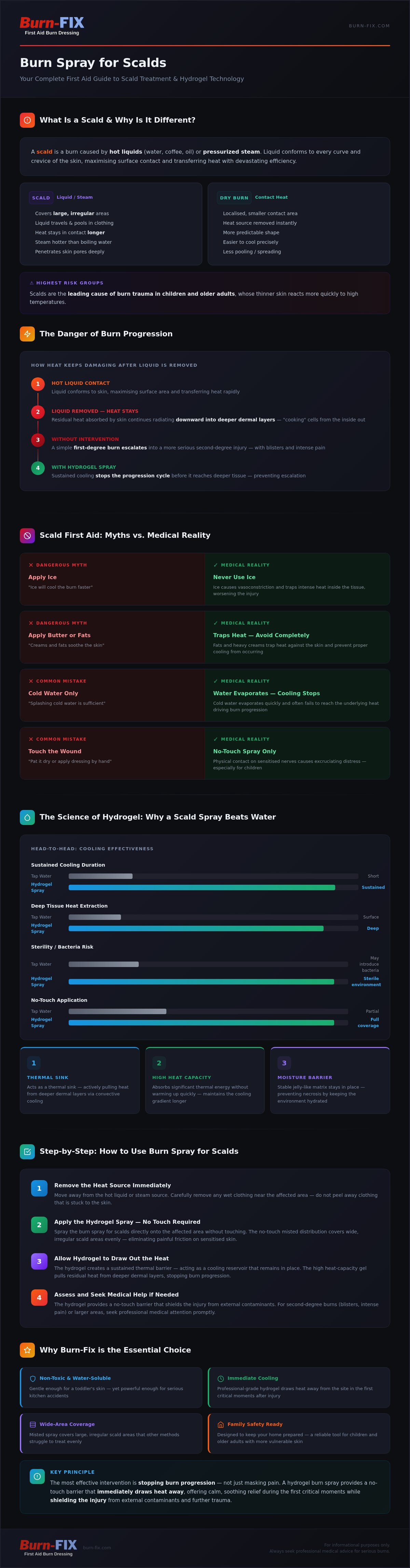
Even after you've wiped away the hot liquid, the injury hasn't stopped. The heat absorbed by your skin continues to radiate downward into deeper dermal layers, effectively "cooking" healthy cells from the inside out. This is why a professional burn spray for scalds is so vital; it does more than just cool the surface. Burn progression is the continued damage caused by residual heat trapped within the skin tissue. Traditional methods like splashing cold water might provide a moment of relief, but they often fail to reach the underlying heat that drives this progression. Without a specialized intervention to draw that thermal energy out, a simple first-degree burn can quickly escalate into a more serious second-degree injury characterized by blisters and intense pain. Using a hydrogel-based solution ensures that the cooling is sustained and deep enough to stop this cycle before it reaches deeper tissue.
The Science of Hydrogel: Why a Scald Spray Beats Water
Hydrogel is a sophisticated polymer network designed to hold vast amounts of water in a stable, jelly-like matrix. Unlike tap water, which quickly evaporates or runs off the skin, this molecular structure creates a consistent cooling reservoir. When you apply a burn spray for scalds, you aren't just wetting the surface; you're applying a medical-grade cooling engine. This hydrogel remains in place, providing a sustained thermal barrier that continues to work long after the initial application. This stability is vital for preventing necrosis, or skin cell death, by keeping the environment hydrated and the temperature controlled.
Standard Mayo Clinic burn first aid emphasizes the importance of cooling the site immediately. While cool running water is a good starting point, hydrogel offers a superior physiological benefit through convective cooling. It acts as a thermal sink, actively pulling heat from the deeper dermal layers and wicking it away from the body. Because the gel is water-soluble and non-toxic, it provides a sterile environment that is much safer than potentially contaminated tap water, which can introduce bacteria into compromised skin.
How Hydrogel Extracts Heat from Deep Tissue
The thermodynamics of hydrogel are straightforward yet powerful. Heat naturally moves from a high-temperature area, like your scalded skin, to a lower-temperature substance, like the gel. Because the gel has a high heat capacity, it can absorb a significant amount of thermal energy without warming up quickly itself. This allows the cooling process to reach deep into the tissue where residual heat often lingers. Maintaining this gradient is what stops the "cooking" process mentioned earlier, ensuring the injury doesn't progress into deeper, more dangerous territory.
Benefits of 'No-Touch' Spray Application
Scalds are notoriously painful because they often affect large, irregular areas of the body. Physical contact on these sensitized nerves can cause excruciating distress, especially for children. A "no-touch" spray application eliminates this friction entirely. It allows for an even, misted distribution of the cooling agent over the entire wound site, regardless of its shape or location. This method also significantly reduces the risk of infection, as there is no need to use hands or cloths that might carry pathogens. For reliable, immediate intervention in your kitchen or workspace, keeping a BurnFix Hydrogel Burn Spray - 120ml nearby ensures you can start the cooling process without causing additional trauma to the victim.
Scald First Aid: Critical Myths vs. Medical Reality
Pantry remedies are often the first thing people reach for during a kitchen emergency. While the instinct to act is good, applying household items like butter, flour, or toothpaste can severely complicate a scald injury. These substances aren't sterile and can easily introduce bacteria into sensitive, compromised skin. More importantly, they create a thick, suffocating barrier that traps heat against the body. This prevents the essential cooling needed to stop burn progression. Using a professional burn spray for scalds is the only way to ensure you're providing a clean, effective intervention that supports natural recovery without trapping the very heat you need to remove.
The Thermal Shock of Ice
Ice feels like the logical answer to a heat-based injury. In reality, it can be as damaging as the burn itself. Applying ice or ice-cold water causes immediate vasoconstriction, where blood vessels shrink and restrict the flow of oxygen-rich blood needed for tissue repair. This extreme temperature drop can lead to frostbite on top of the already traumatized skin cells. Medical standards dictate a 'Goldilocks' approach. The temperature should be cool enough to extract heat through convection but never cold enough to cause thermal shock or further tissue death. Maintaining this balance is critical for preserving the healthy skin surrounding the scald site.
Why Ointments and Creams Fail Fresh Scalds
Creams and greasy ointments are designed to moisturize healthy skin, but they act as insulators on a fresh scald. They lock the thermal energy inside the dermal layers, essentially extending the 'cooking' time of the tissue. If professional medical help is eventually required, these greasy substances are notoriously difficult and painful to remove from raw skin. A hydrogel-based burn spray for scalds is water-soluble, meaning it can be rinsed away easily by a doctor without causing further trauma. Knowing when to choose hydrogel vs hydrogel for burns depends entirely on the wound stage. Hydrogel is the gold standard for the immediate cooling and pain cessation phase, while hydrocolloid dressings are better suited for later-stage protection once the heat has been fully extracted.
Effective first aid is about removing the threat, not covering it up. By avoiding these common myths, you protect the skin's ability to heal itself. Always prioritize active cooling over passive coverage in the first few minutes of a scald injury.
Step-by-Step: How to Use Burn Spray for Scalds
When a scald occurs, the first minute is your most valuable window for intervention. Speed is essential, but it must be paired with precision to avoid making the injury worse. Your primary goal is to stop the thermal transfer immediately. Start by removing the victim from the heat source and gently taking off any clothing or jewelry near the site. Rings, watches, and bracelets can become dangerous tourniquets as the skin begins to swell. If clothing is stuck to the burn, don't pull it; instead, cut around the area to leave the adhered fabric for a medical professional to handle.
The First 60 Seconds: Preparation for Spraying
Once the area is clear of obstructions, you need to stabilize the skin temperature. Flush the site with room-temperature water for a few moments to rinse away any remaining hot liquid. After this brief rinse, you're ready to apply a professional burn spray for scalds. This ensures the hydrogel can make direct contact with the skin without debris or residual heat from clothing interfering with the cooling process. This preparation phase is what allows the hydrogel to work most effectively at the molecular level.
Apply the Burn-Fix Hydrogel Burn Spray liberally over the entire affected area. Hold the bottle about four to six inches away and spray until the wound is completely covered in a thick, shimmering layer of gel. The no-touch application is vital because it prevents the mechanical pain of rubbing or spreading a traditional cream. You'll feel the cooling sensation almost instantly as the gel begins to wick away the trapped heat from the deeper tissue layers.
Long-Term Care and Blister Prevention
Recovery is a process that requires consistent attention. As the initial cooling sensation fades, reapply the spray to maintain comfort and keep the tissue hydrated. If blisters begin to form, you must follow the 'Do Not Pop' rule. These blisters are your body's natural sterile bandages; breaking them open increases the risk of infection and slows down the healing of the underlying tissue. Using hydrogel consistently keeps the area supple, which prevents the skin from tightening and cracking as it heals.
Monitor the injury closely over the next few hours to identify any signs that require professional help. While most minor scalds are treatable at home, you should seek emergency care if the burn covers a large area, involves the face or joints, or if the skin appears white or leathery. For deeper second-degree burns that require a physical barrier against contaminants, transition from a spray to a sterile 4x4 burn dressing once the initial heat has been extracted. To ensure your home is ready for a liquid burn emergency, you can secure a bottle of BurnFix Hydrogel Burn Spray for your kitchen first aid kit today.
Why Burn-Fix is the Essential Choice for Scald Relief
Scalds rarely affect just a tiny spot. Because hot liquids flow and splash, the resulting injury often covers a significant portion of a limb or the torso. This is where the BurnFix Hydrogel Burn Spray - 120ml provides a clear advantage. Its generous volume allows for full-body or large-scale coverage without the fear of running out mid-treatment. Professional first responders and doctors recommend our hydrogel formula because it offers the rapid, convective cooling required to neutralize liquid heat before it causes permanent damage. By making this specialized burn spray for scalds a cornerstone of your medical supplies, you ensure that you're prepared for the unique challenges of a high-volume liquid burn.
A Family-Safe Formula for All Ages
Safety is our primary focus, especially when children are involved. Our hydrogel is a non-toxic, water-soluble formula that contains no harsh chemicals or stinging agents. This makes it gentle enough for a toddler's sensitive skin, providing immediate relief without the added trauma of a painful application. Parents can act with confidence, knowing they're using a doctor-recommended solution that won't interfere with future medical treatment. The Burn-Fix spray bottle is designed for long-term reliability and a stable shelf-life, ensuring it's ready to perform the moment a kitchen accident occurs. It's the supportive, expert voice you want in the room when a minor crisis strikes.
Completing Your Emergency Prep
A well-stocked kitchen safety first aid kit is incomplete without a dedicated liquid spray. While gel packets are excellent for small contact burns, every emergency burn kit for home needs a high-volume spray to address the unpredictable nature of boiling spills. For comprehensive protection, many families combine the 120ml spray for home use with our 3.5g BurnFix Burn Gel packets for portable, on-the-go relief during camping or travel. This tiered approach ensures you have the right tool for every scenario, from a small steam burn to a larger scald.
Don't wait for an accident to realize your first aid kit is missing its most important component. Taking proactive steps now can mean the difference between a controlled recovery and a traumatic hospital visit. Protect your home with the Burn-Fix Hydrogel Burn Spray today and gain the peace of mind that comes with professional-grade protection.
Be Prepared for the Unpredictable Nature of Kitchen Scalds
A scald injury happens in a heartbeat, but the decisions you make in the first sixty seconds determine the path to recovery. You've learned that liquid heat is uniquely aggressive, conforming to the skin and driving thermal damage deep into the tissue. By choosing a professional burn spray for scalds over dangerous home remedies, you're actively neutralizing that heat and shielding your body from further trauma. Our doctor-recommended formula provides instant cooling technology that's safe for every family member, from toddlers to grandparents. This no-touch solution ensures you can provide relief without the added pain of physical contact on sensitized nerves.
It's about having the right specialist in your first aid kit before the emergency occurs. Stop the pain, prevent burn progression, and ensure your home is a sanctuary of safety. Equip your kitchen with Burn-Fix Hydrogel Spray for instant scald relief and gain the confidence of a professional first responder today. You don't have to face a burn emergency alone when you have the right science on your side.
Frequently Asked Questions
Is burn spray better than cold water for a scald?
Using a specialized burn spray for scalds is significantly more effective than cold water alone. While running water is a good immediate step, it only cools the surface and stops working the moment you turn off the tap. Hydrogel remains on the site, providing a continuous thermal sink that pulls heat from deeper tissue layers. This sustained cooling is what prevents a first-degree burn from progressing into a more serious injury.
Can I use Burn-Fix spray on a child who was scalded by hot tea?
You can absolutely use Burn-Fix on a child. Our formula is non-toxic and contains no harsh chemicals or stinging agents that would cause further distress. It's designed to be gentle on a toddler’s sensitive skin while providing the medical-grade relief needed for hot tea or water spills. The no-touch application is particularly helpful for children because it eliminates the need for painful rubbing or spreading of creams.
How often should I reapply the hydrogel spray to a scalded area?
You should reapply the spray whenever the initial cooling sensation begins to diminish or if the gel layer appears to be drying out. Keeping the area consistently moist is vital for preventing skin cell death and reducing the risk of scarring. In the first few hours after an injury, you might find yourself reapplying every thirty to sixty minutes to maintain maximum comfort and hydration levels.
Will using burn spray prevent my scald from blistering?
While no treatment can guarantee a blister-free recovery, using a burn spray for scalds immediately after the injury can drastically reduce the likelihood and severity of blisters. By extracting trapped heat before it destroys the underlying dermal layers, you stop the cooking process that leads to fluid buildup. Rapid intervention is the most reliable way to protect your skin's integrity and speed up the natural healing process.
What should I do if my clothing is stuck to the scalded skin?
If fabric is adhered to the wound, leave it exactly where it is. Attempting to peel away stuck clothing can tear the compromised skin and lead to severe infection or scarring. Instead, cut the loose clothing away from the area and apply the hydrogel spray directly over the fabric. This will cool the site until a medical professional can safely remove the material in a sterile environment.
When does a scald require a trip to the emergency room?
You should seek immediate medical attention if the scald covers an area larger than the victim's palm or if it involves the face, hands, feet, or genitals. Additionally, any burn that appears white, charred, or leathery requires an emergency room visit. If the pain remains intense despite first aid or if you notice signs of infection like spreading redness or fever, consult a healthcare provider right away.
Can I use burn spray for scalds on my face or neck?
Yes, the hydrogel formula is safe for use on the face and neck. These areas have thinner skin and are highly sensitive, making the no-touch spray application an ideal choice. When applying near the eyes or mouth, you can spray the gel onto a clean hand first and gently dab it onto the site. This ensures full coverage while keeping the cooling agent away from your mucous membranes.
Is it safe to cover a scald with a bandage after spraying?
It is safe and often recommended to cover the area once the initial heat has been neutralized. A sterile, non-adherent dressing like the Burn-FIX 4x4 First Aid Burn Gel Dressing provides a protective barrier against bacteria and environmental contaminants. Applying a bandage over the hydrogel helps maintain the moist environment needed for healing while preventing the gel from being rubbed off by clothing or bedding.


