


A friction burn is never just a simple scrape; it is a painful hybrid injury that couples mechanical tearing with intense, trapped heat. Acting quickly with proper first aid for friction burns makes the difference between rapid healing and weeks of painful complications. If you are nursing that fiery, relentless stinging right now, you understand how vulnerable raw skin feels. It's completely natural to fear infection, stress over embedded grit, or worry about a permanent scar forming on your skin.
You don't have to endure the throbbing ache or second-guess your recovery steps. In this guide, you'll learn how to accurately assess, cleanse, and soothe friction injuries, from simple carpet burns to harsh road rash, using professional first-aid techniques that eliminate pain and prevent scarring. We'll guide you step-by-step through neutralizing hidden dermal heat, flushing out contaminants safely, and applying moisture-rich hydrogel barriers that protect your skin without sticking to raw wounds.
Key Takeaways
- Understand the dual anatomy of friction burns, which combine surface abrasions with residual kinetic heat that continues to damage delicate tissue beneath the surface.
- Master the essential steps of first aid for friction burns to soothe intense stinging quickly without worsening cellular injury.
- Discover the critical triage criteria that separate minor surface scrapes from serious wounds requiring prompt emergency evaluation.
- Explore modern moist-healing science to see why preventing hard scabs accelerates recovery, minimizes scarring, and keeps dressings from sticking to exposed dermis.
- Implement long-term barrier protection and UV defense strategies that shield vulnerable skin layers to keep permanent discoloration from taking hold.
What is a Friction Burn? Understanding the Injury
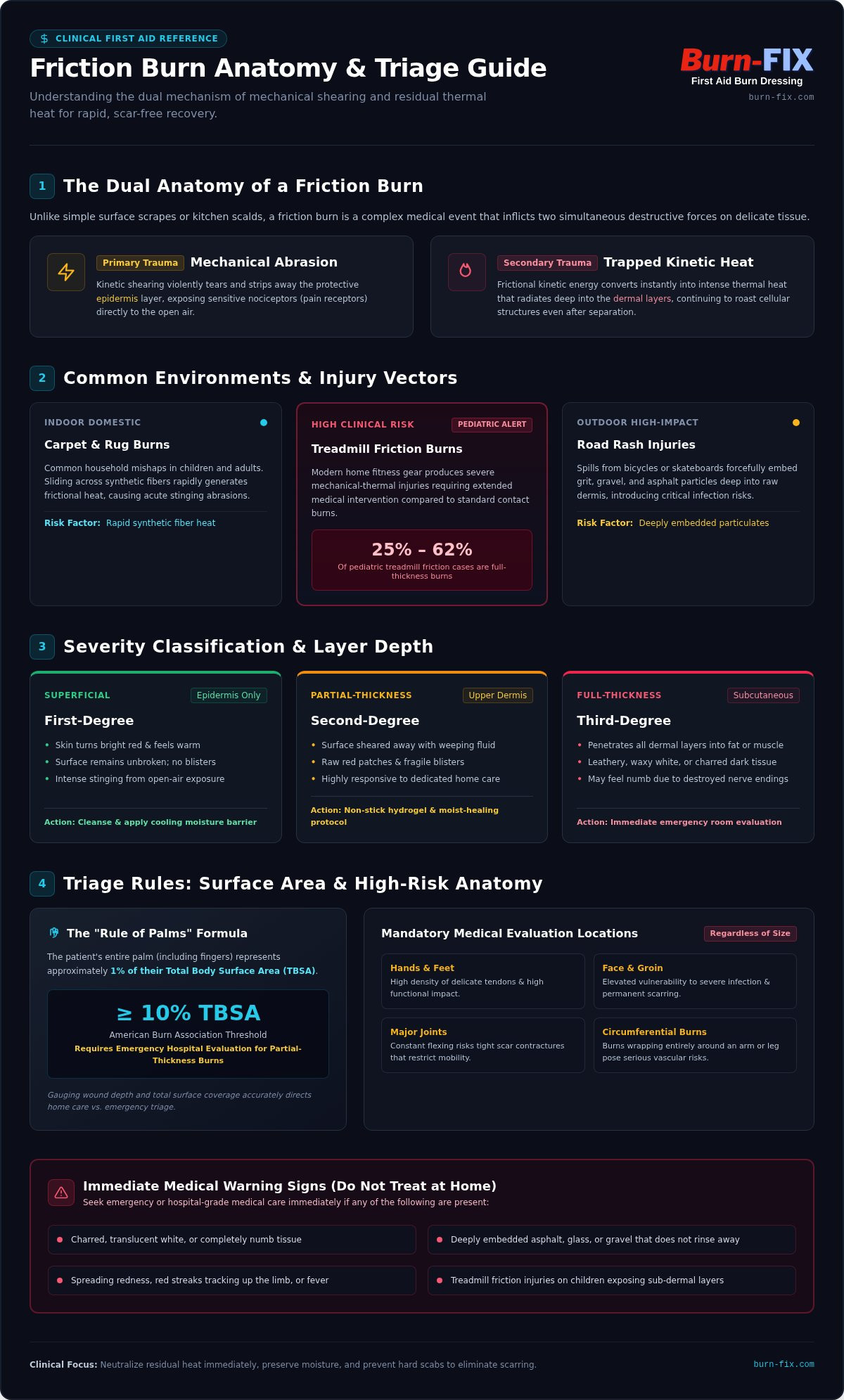
Friction burns are unique medical events. Unlike a kitchen scald or a surface scrape, a friction burn is a dual-action trauma: part mechanical abrasion and part thermal contact burn. When skin slides forcefully against a coarse surface, kinetic energy instantly converts into intense frictional heat. This rapid friction strips away the protective epidermis while thermal energy radiates into the vulnerable dermal layers beneath.
People refer to these painful injuries by everyday names like rug burns, carpet burns, floor burns, or road rash. Yet regardless of what caused it, the clinical reality remains the same. The medical literature on friction burn characteristics and causes confirms that physical shearing and acute thermal energy combine to produce severe, acute tissue irritation. Knowing proper first aid for friction burns begins with recognizing that you are managing both a deep scrape and an active heat injury.
Common Scenarios: From Carpet to Treadmills
Friction burns happen across diverse environments, each presenting distinct risks to your skin:
- Carpet and rug burns: Frequent household mishaps, often seen in children sliding across synthetic fibers that quickly generate friction heat.
- Treadmill burns: Modern home fitness gear accounts for surprisingly severe friction injuries. Pediatric burn center data indicates that 25% to 62% of pediatric treadmill friction injuries are full-thickness burns, demanding extended medical care compared to typical contact burns.
- Road rash: Outdoor spills from bicycles or skateboards forcefully embed grit, gravel, and asphalt into raw dermis, creating a severe infection risk.
Why Friction Burns Sting More Than Regular Scrapes
The pain hits immediately. Simple scrapes tear outer cells, but friction burns physically strip the epidermis while roasting the delicate upper dermis. This double trauma exposes sensitive nociceptors (pain receptors) to open air, creating an agonizing, raw sting.
Hidden heat creates the real danger. Even after you pull away from the rough surface, residual thermal energy lingers within the dermal tissue, continuing to damage cells unless actively neutralized. That is why basic dry bandaging fails on fresh injuries. Applying targeted first aid for friction burns requires immediate cooling to halt thermal progression before you ever attempt to clean or cover the wound.
Assessing Severity: When is a Friction Burn an Emergency?
Accurate triage saves skin. Because friction injuries grind dirt and synthetic debris deep into raw tissue, gauging wound depth by sight alone can be tricky. A rigorous clinical assessment of friction burns looks past surface discoloration to evaluate structural damage across specific dermal layers.
Classifying the damage directs your next action:
- First-degree: The skin turns bright red, feels warm, and remains unbroken. It stings intensely, but no blisters appear.
- Second-degree (partial-thickness): The surface shears away, causing clear fluid weeping, raw red patches, and fragile blisters. These injuries respond best to early, dedicated first aid for friction burns at home.
- Third-degree (full-thickness): The trauma penetrates all dermal layers into fat or muscle. The area looks leathery, waxy white, or charred dark. Counterintuitively, it may not hurt at all because local nerve endings have been destroyed. These injuries always demand immediate emergency care.
The 'Rule of Palms' for Surface Area
Size matters as much as depth. In first-aid triage, the patient's palm (including the fingers) represents roughly 1% of their total body surface area. The American Burn Association recommends emergency hospital evaluation if partial-thickness burns cover 10% or more of the body.
Location also changes the stakes. Any friction injury involving the hands, feet, face, groin, or major joints requires professional medical evaluation. Skin over joints flexes constantly, meaning improper healing can cause tight scar contractures that restrict mobility. Likewise, circumferential burns that wrap entirely around an arm or leg present serious vascular risks.
Red Flags: When to Seek Immediate Medical Help
Don't attempt home treatment if you encounter any of these clear warning signs:
- Charred, translucent white, or completely numb tissue
- Deeply embedded asphalt, glass, or gravel that doesn't rinse away under gentle irrigation
- Spreading redness, red streaks tracking up the limb, worsening swelling, or fever
- Treadmill injuries on small children that expose sub-dermal tissue
If the injury is a minor first- or second-degree burn, keeping a well-stocked first aid kit for burns on hand ensures you can soothe the fire and protect vulnerable tissue without delay.
The Science of Healing: Why Moisture and Cooling Matter
Old first-aid habits die hard. For decades, traditional advice told people to let raw wounds "air out" and form a thick, protective scab. Modern dermatological science proves the opposite is true. When a wound dries into an eschar (hard scab), migrating epithelial cells must burrow underneath the crust to close the gap. Maintaining a physiologically moist wound environment accelerates epithelial cell migration by up to 40% to 50% compared to dry exposure. Moisture speeds healing and dramatically lowers the chance of long-term scarring.
Prompt cellular repair depends on continuous hydration. Without an intact epidermal barrier, raw skin rapidly loses moisture through evaporation, exposing delicate tissues to ambient bacteria. Applying evidence-based first aid for friction burns requires immediate heat extraction followed by a protective moisture seal that mimics your skin's natural barrier.
The Danger of Ice and Home Remedies
Never put ice on a burn. While extreme cold sounds intuitive for a fiery wound, ice triggers severe vasoconstriction, choking off local capillary blood supply and causing deeper tissue death. Kitchen remedies like butter, margarine, or flour are equally destructive. They seal in lingering dermal heat, introduce foreign bacteria, and guarantee a painful cleaning ordeal at the clinic.
Heavy ointments pose a subtle risk too. Applying thick petroleum jelly or oily salves before the wound has fully cooled traps residual heat in the dermis, converting minor injuries into deeper burns. Standard protocols like the Mayo Clinic first-aid burn treatment guide emphasize thorough cooling under cool water or dedicated water-based agents before applying any protective coverings.
Hydrogel: The Professional Standard for Friction Relief
Cooling without complications is why specialized hydrogels have become the gold standard in modern trauma care. High water-content hydrogel pulls residual heat directly out of the dermis through gentle heat conduction. This immediate temperature drop brings instant, soothing relief to hypersensitive nerve endings without constricting fragile micro-vessels.
Hydrogel also solves the dreaded "stuck bandage" problem. When plain dry gauze touches a weeping friction burn, proteins and fibroblasts weave directly into the cotton fibers. Peeling off that dry dressing rips away fresh new skin, restarting the inflammatory cycle and increasing scar formation. A moisture-rich hydrogel barrier keeps the wound bed supple, ensuring painless dressing changes while healthy new skin repairs itself beneath.
Step-by-Step First Aid for Friction Burns
Fast action halts tissue damage. When dealing with a fresh injury, executing systematic first aid for friction burns controls pain quickly while defending the raw dermal bed against bacterial invasion. Follow this chronological protocol:
- Cool the heat: Immediately place the burn under clean, cool running tap water for 10 to 20 minutes. This lowers the temperature of overheated tissue and calms firing nerve endings.
- Cleanse gently: Flush away loose dirt, synthetic fibers, or gravel. Avoid vigorous scrubbing, which tears fragile cell margins.
- Neutralize residual burning: Apply a sterile hydrogel layer to draw out lingering heat and create an immediate protective moisture shield.
- Dress with non-adherent coverage: Cover the area with a non-stick pad and secure it lightly with cohesive bandage tape.
- Track recovery: Monitor the wound closely over the first 48 hours for swelling, foul odor, spreading heat, or unexpected drainage.
Cleaning Road Rash and Dirty Friction Burns
Contamination demands careful handling. When dirt, asphalt grit, or carpet fuzz remains embedded in the wound bed, skin cells can heal over the particles, causing permanent disfigurement known as traumatic tattooing. Copious low-pressure irrigation using sterile saline or cool tap water washes away debris naturally.
Touching raw nerves can feel unbearable. When physical contact causes sharp pain, using a touch-free burn relief spray allows you to deliver soothing hydration across wide abrasions without touching fragile tissue. Once clean, gently pat the surrounding healthy skin dry with sterile gauze rather than rubbing across the wound bed.
Remember your immunization status. The CDC designates friction injuries with broken skin or dirt contamination as dirty wounds. If your last tetanus booster was five or more years ago, contact your physician promptly.
Applying the Right Dressing
Never place standard woven cotton pads on raw, weeping flesh. Exudate quickly cements cotton fibers to the wound bed, creating severe pain during removal. Choose a dedicated non-adherent hydrogel dressing or non-stick pad that protects delicate keratinocytes during cellular migration.
Wrap the dressing loosely with flexible conforming gauze. Tight wraps restrict micro-vascular circulation, starving healing skin of vital oxygen and blood flow. Change the outer dressing once daily, or immediately if drainage soaks through the perimeter.
Equip your medicine cabinet with a specialized BurnFix Burn Kit to ensure you have professional, non-stick dressings and doctor-recommended hydrogels ready the moment an accident happens.
Recovery and Prevention: Your Home Safety Strategy
Recovery doesn't end when the initial stinging subsides. Once fresh pink skin covers the wound bed, that delicate new tissue remains hyper-reactive to ultraviolet rays. Exposing fragile recovery tissue to sunlight triggers post-inflammatory hyperpigmentation, locking in stubborn dark discoloration that can linger for months or years. Applying broad-spectrum sun protection and maintaining continuous skin hydration are just as vital as your emergency response. Diligent follow-through cements the work of early first aid for friction burns, ensuring smooth, scar-free healing.
Essential Supplies for Friction Burn Care
Accidents happen without warning. Being caught unprepared when someone suffers a severe carpet burn or sports abrasion turns a manageable injury into a stressful scramble. Assembling a dedicated emergency burn kit for home ensures you have medical-grade supplies ready before panic sets in.
Stock materials that target both surface abrasions and lingering heat. Standard adhesive bandages stick directly to raw cells, whereas a Burn-FIX 4x4 First Aid Burn Gel Dressing cushions exposed nerve endings with sterile hydrogel that lifts off cleanly without pain. Stash portable 3.5g BurnFix Burn Gel packets inside gym bags, cycling kits, or athletic lockers for instant relief on the go. If you are already organizing your household supplies, integrating burn care into your kitchen safety first aid kit provides your family with rapid, reliable defense against thermal and friction trauma alike.
Preventing Future Friction Injuries
Proactive prevention keeps skin intact. Athletes, outdoor runners, and cyclists can minimize road rash risks by wearing abrasion-resistant synthetic layers that slide smoothly against surfaces rather than catching and tearing the dermis.
Inside the house, fitness machines require strict safeguards. Always attach the wearable safety-lanyard stop-key when operating a treadmill, and verify that at least six feet of clear space remains behind the belt. Small children face high risks around active exercise machines, making physical room barriers essential when equipment runs. For toddlers playing indoors, set clear rules against fast sock-sliding on rough rugs. Simple precautions prevent devastating injuries, sparing your family the distress of needing urgent first aid for friction burns.
Take Control of Friction Healing with Confidence
Healing a painful friction injury doesn't have to be a guessing game. By recognizing that these abrasions trap active thermal heat inside delicate tissue, you can execute effective first aid for friction burns with total certainty. Cool the wound immediately under clean water, rinse away contaminants gently, and leave outdated dry-healing myths behind. Supporting raw tissue with sterile, moisture-retaining care cuts recovery time down while shielding your skin from disfiguring scars.
When sudden accidents strike, having advanced first-aid supplies ready turns a chaotic moment into a calm, soothing recovery. Equip your home with professional-grade Burn-Fix Hydrogel today to keep doctor-recommended sterile dressings on hand. With non-stick technology engineered for painless changes and instant cooling relief for friction and heat burns, you can quiet painful nerve endings fast and protect your family's skin through every step of repair.
Frequently Asked Questions
How long does it take for a friction burn to heal?
Minor superficial friction burns typically heal within three to seven days, while deeper partial-thickness burns take two to three weeks. Healing speed depends heavily on wound moisture and care. If the injury exposed raw dermal layers or suffered grit contamination, cell regeneration requires continuous barrier support. Severe injuries, like pediatric treadmill burns that breach deeper tissues, can take several weeks or require medical oversight to heal completely without contractures.
Should I keep a friction burn covered or let it breathe?
You should keep a friction burn covered with a sterile, non-stick dressing rather than letting it air out. Leaving raw tissue exposed dries it into a hard scab, which slows skin regeneration by forcing cells to dig underneath to close the gap. A breathable, moisture-retaining dressing protects exposed nerve endings from airborne bacteria and friction, accelerating tissue repair while stopping the dressing from painfully tearing off healing skin.
Can I put Neosporin or antibiotic ointment on a friction burn?
You should avoid routine over-the-counter antibiotic ointments containing neomycin or bacitracin because they frequently trigger allergic contact dermatitis. This irritation often mimics an active infection, causing unnecessary redness and swelling. Instead, once the wound has been cooled for at least ten minutes, dermatologists recommend plain white petrolatum or sterile hydrogel. These options maintain a safe moisture barrier without provoking allergic skin reactions.
What is the difference between road rash and a friction burn?
Road rash is a specific type of severe friction burn that occurs when skin slides across rough surfaces like asphalt or concrete. While indoor carpet burns usually involve clean synthetic friction, road rash introduces significant mechanical trauma and embedded environmental debris like dirt, pebbles, and glass. Both injuries involve thermal heat and epidermal loss, but road rash requires rigorous flushing during initial first aid for friction burns to avoid traumatic tattooing.
How do I stop a friction burn from stinging immediately?
Cool running tap water applied for 10 to 20 minutes provides the fastest, safest immediate relief from stinging. Lowering tissue temperature calms hyperactive pain receptors and halts lingering heat progression. Right after cooling, applying a water-based hydrogel spray or gel dressing coats exposed sensory nerves with a soothing layer of moisture. This stops air from hitting open nerve endings while avoiding ice, which risks severe tissue damage.
Will a friction burn leave a permanent scar?
Superficial first-degree friction burns rarely leave permanent scars, but deeper burns that destroy dermal tissue carry a higher scarring risk. You can prevent lasting marks by maintaining a moist wound environment and avoiding picking at scabs. Once the raw area re-epithelializes into fresh pink skin, shield it diligently from direct sun exposure with broad-spectrum sunscreen for at least six to twelve months to prevent post-inflammatory hyperpigmentation.
Can I use a friction burn spray on children?
Yes, doctor-recommended water-based hydrogel burn sprays are gentle and safe for both children and adults. Friction sprays offer touch-free cooling relief, which is ideal for frightened toddlers whose raw skin hurts when touched. Using a sterile hydrogel spray as part of pediatric first aid for friction burns calms tears quickly without chemical numbing agents or stinging antiseptics, making wound care far less stressful for young families.
What should I do if my treadmill burn starts blistering?
Leave the blister intact and never attempt to pop or debride it at home. The blister roof serves as your body's natural, sterile biological shield, protecting fragile lower dermal layers from infection. Gently rinse the area under cool water, apply a non-adherent hydrogel pad, and loosely secure it with conforming bandage wrap. If blisters cover hands, joints, or larger body areas, seek medical evaluation immediately.


